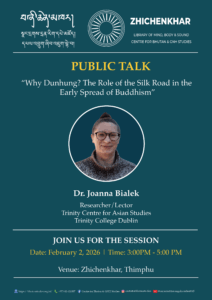
Please join us for our upcoming public talk on Monday, February 2, at Zhichenkhar. For registration, kindly visit this Form
Abstract
The Silk Road, a network of trade routes connecting eastern Asia with the Mediterranean via Central Asian oases, played a pivotal role in the earliest expansion of Buddhism from its place of origin in India. As merchants, pilgrims, and missionaries travelled along these routes, they facilitated not only the exchange of goods such as silk, spices, and tea but also ideas and religious practices.
The earliest traces of Buddhism in Central Asia date to the 1st century CE, when it began to influence local cultures through interactions with Buddhist pilgrims and merchants mainly from the Kushan Empire. The Silk Road not only allowed for the physical movement of religious objects and scriptures but also enabled a rich cross-cultural dialogue that shaped the development of Buddhism in diverse ways. Buddhist monasteries and stupas were established along the route, becoming centres of both trade and religious teaching. Monks who travelled along the Silk Road fostered the translation of Buddhist scriptures, contributing to the spread of Buddha’s word.
One of the most notable sites on the Silk Road was the city of Dunhuang in modern-day Gansu Province (PRC), which became a major centre of Buddhist scholarship in the first millennium CE. Through their military conquests of the 7th to 9th centuries, Tibetans came to politically control large stretches of the Tarim Basin, on the eastern fringes of which Dunhuang is located. In my talk, I will present the current state of knowledge on the prominent role the Dunhuang oasis and the nearby Buddhist complex of Mogao Caves played in familiarising Tibetans with Buddhist thought, challenging the traditional view of the Indian provenance of Tibetan Buddhism.